How AI Is Quietly Changing the Everyday Work of HR Teams
HR teams hardly ever have the time to do one thing at once. The usual duties include a mix of checking the attendance, answering employee inquiries, verifying documentation, organizing the onboarding process, conducting follow-ups, preparing reports, and providing data for manager inquiries concerning the workforce etc.
All of these tasks are essential, but most of them are quite repetitive. With the increasing size of the organization, the volume of information and requests grows rapidly and becomes almost impossible to handle manually.
Here is when artificial intelligence quietly starts enhancing the daily work of the HR team. It is not about replacing the HR workers; it is about minimizing repetitive tasks, structuring information, spotting patterns, and leaving room for decision-making.
From Manual HR Work to Intelligent Workflows
Classic HR operations involve using email, spreadsheet programs, standalone applications, and even manual processes. An ordinary request for an employee might need to pass through several individuals before being fulfilled.
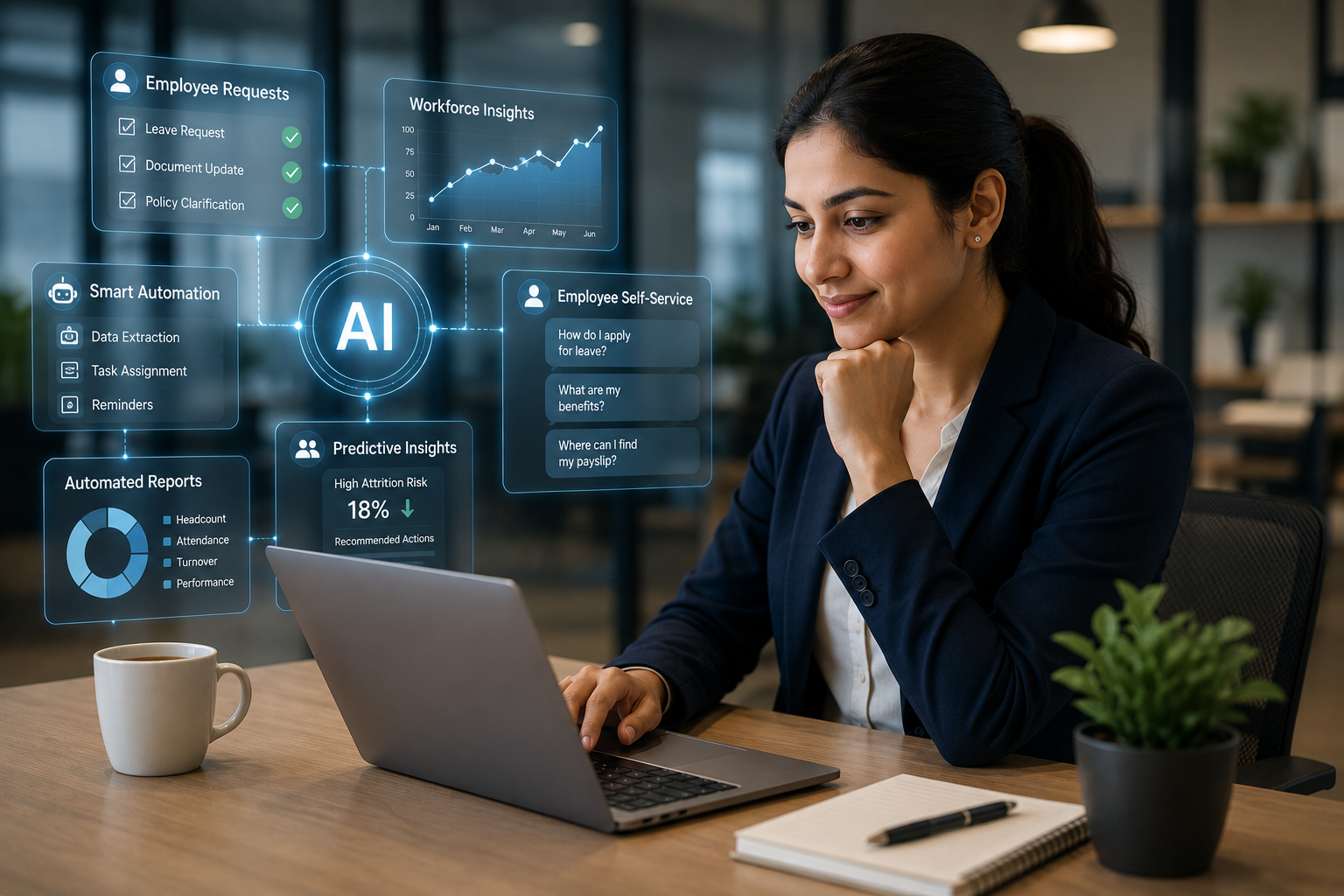
In that regard, AI can be used to ease some of those processes, automating routine actions and the transfer of data among interlinked processes. This includes using systems to help sort out the requests made by employees, detect any missing data, produce routine reports, and assigning tasks to the right person.
The point here is not simply about making things faster. The idea here is more about making fewer routine tasks that usually take away time from other important HR tasks.
Rather than spend countless hours making sure that all routine tasks have been completed, HR personnel can focus on helping employees, planning their workforce, engagement, and organizational development.
Where AI Is Making Everyday HR Tasks Easier
The implementation of AI in HR is often not as spectacular as people think. In most cases, it won't be a fully automated HR department. It will be seen in small steps taken in various functions of daily life.
In recruiting, AI can help sort out the applicants and select useful information from an immense flow of candidates' data. In onboarding, it can help new employees go through the standard procedures and give answers to standard questions.
As for current employees, AI can make it easier for them to get the necessary information about any HR process, policy, leave, or benefits without HR being busy answering all their routine questions.
AI can help in document management, reporting, workforce analytics, and routine communication.
If all those small changes are implemented in the context of the whole employee experience, it will significantly decrease the load on HR teams.
For businesses looking to bring more intelligence into everyday HR operations, exploring an integrated HR platform can be a practical starting point.
TheCloudTree.ai® helps organizations connect HR processes and workforce information in one place, making it easier for teams to reduce manual work and focus on more meaningful priorities.
The New Role of HR Data
Any organization accumulates lots of information about its employees.
There is recruitment data showing who was hired recently. There is attendance data that shows the presence or absence of the employees. Payroll data gives the information about how much workforce costs the organization. Information on performance and learning can hint on where the employees need improvement.
The problem is in collecting the data accurately and in understanding it.
AI can help HR specialists in identifying patterns in the data sets that may be hard to identify otherwise. Patterns like absence in the department, movement of the workforce, or high demand for certain skills can be very useful information for the managers.
But not every pattern in the data means a problem.
There can be many reasons for the increased absence, and the increased movement of the employees can be the result of business development, not of dissatisfaction.
AI can highlight the signal. But understanding what stands behind it is up to HR specialists.
AI as an Assistant, Not a Replacement
Another prevalent misconception regarding AI in HR concerns automation replacing HR personnel entirely in the future.
Indeed, many of the critical tasks performed by HR personnel rely heavily on attributes that are not easy to emulate via technological means.
A worker facing a challenging situation could need empathy instead of automation. A supervisor managing a dispute could require assistance grounded in organizational context. A leadership choice might require an awareness of the organizational culture, expectations of the workers, and long-term implications of that decision.
AI might help to facilitate this process by supplying information, summing up data, and recognizing pertinent patterns. Yet the decision itself will require human input.
Thus, the best strategy would be neither AI nor HR but AI combined with HR.
What Human Judgment Still Brings to HR
Humans are complex beings, and workplace decisions are not always as easily quantifiable within a set of data.
While two workers might display comparable statistics in terms of performance, they can very well be faced with entirely different realities. An increase in absenteeism for a certain team can mean that they have more pressing demands in place, have a more demanding workload, or are experiencing particular business conditions.
This is something which HR specialists take into account.
They comprehend conversations, relations, organizational culture, worries of the worker, and business needs. And all these things can sometimes impact decision-making in ways which are not always measurable through data.
And there are significant issues with privacy, transparency, fairness, and proper handling of employee data.
Building a More Responsive HR Function
With the increasing accessibility of AI, HR functions now have the chance to revamp their methods.
It is not a matter of automating every single process. Organizations need to find out where technology can help eliminate friction and where human interaction brings the greatest value.
Common inquiries can be sorted through more effectively. Reports can be generated using less manual labor. Workforce trends can be detected at an earlier stage. Employees can gain quicker access to HR services.
It provides HR personnel with more time to focus on tasks that make a difference for employees and the company's strategy.
Advanced HR solutions like TheCloudTree.ai® can facilitate this transformation by providing a comprehensive space for different workforce processes and data. With technology taking care of the routine work, HR departments can pay more attention to the areas that do not involve technology.
Conclusion
AI is transforming HR, yet not always by announcing itself as such.
It is showing up in the form of enhanced workflow speeds, advanced data analysis, self-service for employees, automation, and improved access to information about the workforce. Each of these advancements might appear as small on its own, but all combined can alter the HR process on a daily basis.
The future of HR doesn’t look like being built on choosing either people or technology, but on using technology in areas it can help while keeping the human judgment crucial for decision-making.
That results in not less human-centered HR, but in more human-focused HR.
Ready to make everyday HR work more efficient? Explore how TheCloudTree.ai® can help your organization simplify HR operations, connect workforce processes, and create a more responsive workplace.
FAQs
How is AI changing everyday HR work?
AI can help HR teams automate repetitive tasks, organize information, analyze workforce data, support employee self-service, and identify patterns that may require attention.
Can AI replace HR professionals?
AI can automate certain administrative activities, but HR professionals remain important for judgment, employee relationships, conflict resolution, culture, and complex people decisions.
How can AI help HR teams use workforce data?
AI can analyze large amounts of workforce information and identify patterns related to attendance, recruitment, employee movement, skills, and other areas that may support workforce planning.
Is AI safe to use with employee information?
AI should be implemented with appropriate security, privacy, access controls, and governance. Organizations should also consider transparency and fairness when using AI for employee-related decisions.
What is the main benefit of AI for HR teams?
One major benefit is reducing repetitive administrative work, allowing HR professionals to spend more time on employee support, workforce planning, engagement, and strategic activities.