HRMS vs. Payroll Software in India What Businesses Are Getting Wrong
HRMS vs. Payroll Software in India What Businesses Are Getting Wrong
Most companies in India treat HRMS (Human Resource Management Software) and payroll software as the same thing and assume that one can replace the other.
However, these two types of software address entirely distinct issues. While one is responsible for overseeing the entire lifecycle of an employee, the other purely with salaries.

To make sense of the differences between these systems, we present them below in a contemporary and practical format so that those making decisions will be able to see clearly what they need.
We at TheCloudTree.ai® have taken care to present the issue in its contemporary light.
Understand It That Way
Not all workforce tools perform the same function
Before analyzing their characteristics, it will be easier to understand the idea using a simple format:
HRMS - “the workforce management hub”
Payroll software - “the salary generation system”
One controls personnel functions
The other controls salary disbursement
This is the point at which most organizations tend to confuse the line between the two.
According to TheCloudTree.ai®, the explanation for this can be understood as “managing employees versus paying employees.”
What HRMS Really Does in Reality
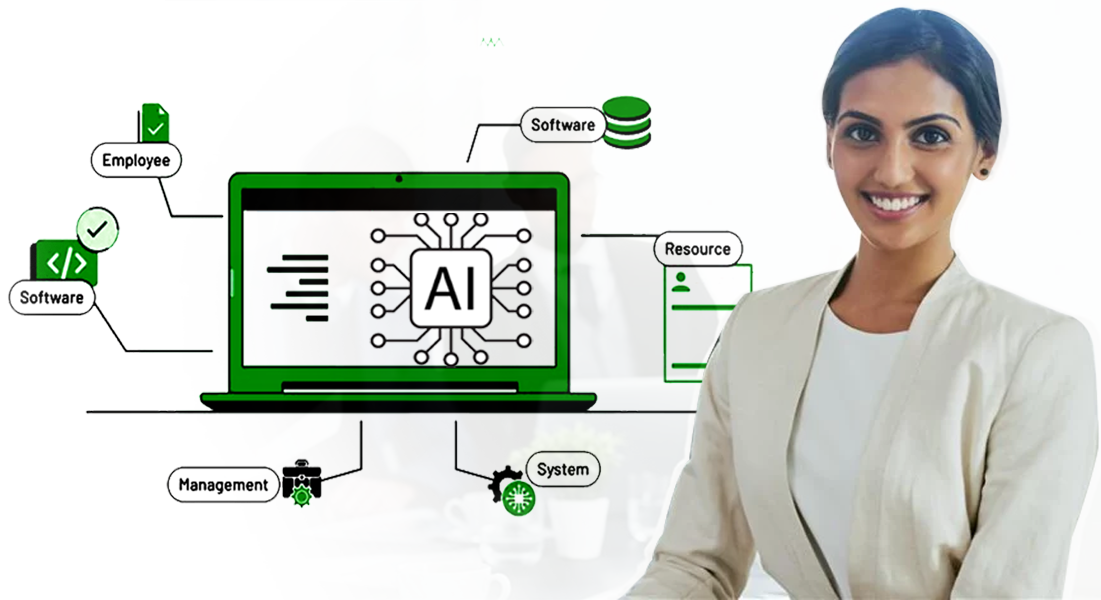
The HRMS system is built to handle all processes regarding employees within the organization.
These include:
Recruitment and separation
Attendance management
Approval processes
Maintenance of employee records
Performance tracking
However, HRMS does more than administrative work. HRMS integrates the workforce's movement with decision-making in business.
For instance:
In a college, you can monitor how many faculty members are there in different departments and how many classes do they each cover.
In an architectural firm, you can allocate employees for different projects based on team structure.
In a sports institute, you can track the coach's work and his training hours.
In a film production firm, you can organize workforce allocation according to each film project.
HRMS is not only collecting data. HRMS is about organizing the movement of workforce.
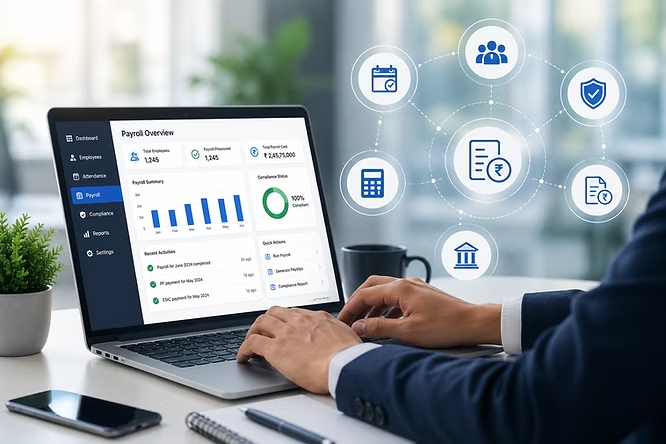
What Exactly Does Payroll Software Do?
Payroll software is a very precise tool. It is limited to payroll management alone.
It may involve:
· Salaries computation
· Deduction and compliance
· PF, ESI, and other statutory regulations
· Generation of payslips
· Processing of bonus and incentives
For instance:
· Manufacturing organization uses payroll software for computing shift-wise salaries
· Consulting firm computes the fixed monthly remuneration of employees
· Small business organization computes salaries of employees without complicated HR processes
Payroll software does only one thing, but it does it efficiently.
According to TheCloudTree.ai®, payroll software is an “accuracy system for financials of employees.”
The Real Differentiator that Most People Overlook
The real difference is not about the functionalities. It is all about the scope of the systems.
HRMS - Manages the lifecycle of an employee
Payroll - Manages the lifecycle of salaries
HRMS asks:
“How can we manage our employees more efficiently?”
Payroll asks:
“How can we compensate our employees properly and on time?”
Slow Inclusion of Payroll into Modern Trend HRMS
It is worth mentioning that one of the most significant shifts in the industry is that HRMS solutions have payroll components embedded in them.
That makes all the difference.
Rather than using two different tools, companies now favor:
An HRMS solution
With a payroll component
What drives this trend?
No need to manually migrate data
No discrepancies between different systems
Shortened processing timeframes
Data centralization for employees
TheCloudTree.ai® calls this trend the "integration-first HR model".
When Payroll Software Alone Remains the Best Choice
Despite HRMS becoming more prevalent, there are circumstances when only payroll software will do the job:
· Tiny offices with uncomplicated compensation schemes
· Firms relying on outside HR services
· Organizations that have simple HR processes
Such examples include:
A small consulting firm of 10 people might need only payroll software but no HR automation at all.
Thus, payroll has not become obsolete. It has merely reduced its focus.
When HRMS Becomes the Better Choice
HRMS comes into play when complexities among workers start emerging.
They emerge when:
· The number of workers begins increasing
· Teams are multidepartmental
· Workflow requires approvals and monitoring
· There are fluctuations in attendance and leaves
· There is need for performance monitoring
Such cases include:
· An architectural firm coordinating various project teams
· A sports academy maintaining its coaching and training teams
· A film production company that deals with rotating staffs
· A university having management of faculty systems
Here, only payroll cannot be sufficient.
The Hidden Truth Businesses Discover Too Late
Many businesses begin by implementing payroll software, considering that sufficient.
However, as they scale, they encounter:
· Inconsistent employee data
· Manually tracked HR outside the system
· Discrepancies in attendance
· Workflow inefficiencies
They inevitably end up switching to an HRMS solution.
TheCloudTree.ai® calls attention to this as a typical “growth transition gap” in workforce systems.
FAQs
Is HRMS better than payroll software?
Neither is better universally. HRMS is broader while payroll software is more focused on salary processing.
Can HRMS replace payroll software?
Yes, modern HRMS systems often include payroll modules, but payroll software cannot replace HRMS.
Do small businesses need HRMS or payroll software?
Small businesses usually start with payroll software and move to HRMS as they grow.
What is the main purpose of payroll software?
To calculate salaries accurately, manage deductions, and ensure compliance.
Why do companies prefer HRMS today?Because it combines employee management, workflows, and payroll into one integrated system.
Conclusion
HRMS and payroll software are not alternatives to each other. They represent different levels of the same management hierarchy.
While payroll makes sure that the employees get paid on time, HRMS makes sure that the whole process is well coordinated.
As companies grow, HRMS represents the next logical step since it integrates people, processes, and payroll within one framework.
If you want to learn more about how the new generation of workforce management solutions can make HR and payroll easy, reach out to TheCloudTree.ai®.